 for
for 
While there are some Notice and Access benefits to companies with hundreds of thousands of shareholders, four out of five companies end up paying as much — or more — going the Notice and Access route than if they just printed and mailed a full set to retail owners. And that number keeps going up. Perhaps more problematically, retail shareholder voting is down around 70% with Notice and Access. In other words, issuers are paying more and getting less. Let’s review some basics, then look at how we got here — and what options we have to decrease costs and improve shareholder engagement.
What is Notice and Access?
Notice and Access, approved by the SEC in 2007, allows retail shareholders to determine how they want to access proxy materials from issuers. Prior to the rule, everything was sent out via paper, but Notice and Access allows retail shareholders to opt in on how they want their proxy materials shared. Shared as a one-page notice, the reason for this rule is for shareholders to avoid receiving large, mailed proxy packages they may not want while the issuer saves on paper costs and helps the environment.
What is the 40 day Notice and Access rule?
Part of the SEC’s rule around Notice and Access is that issuers must send out notice to retail shareholders a minimum of 40 days prior to a shareholder meeting. By sending out notice this far in advance, and by offering more than one way to access proxy information, shareholder voter participation was expected to increase. But as mentioned above, it hasn’t.
Can you use Notice and Access for a special meeting? Yes, unless the meeting is for a business combination — a transaction for the company the retail shareholder invests in to obtain control of another business or businesses — or for a cash-out merger.

Introducing Quinn, our next generation, SaaS platform for the creation, collaboration, publishing, filing and distribution of complex regulatory disclosure documents.
Notice and Access trends issuers should monitor in 2026
While the fundamentals of Notice and Access remain unchanged, issuers are facing new challenges as retail investor behavior continues to evolve. Several trends have emerged:
- Retail investors increasingly expect digital-first communications that provide immediate access to voting materials.
- Companies are placing greater emphasis on shareholder engagement metrics, not just distribution costs.
- Investor relations teams are evaluating the full cost of proxy distribution, including solicitation campaigns needed to support quorum and proposal approval.
- More issuers are exploring hybrid approaches that combine full-set delivery, Notice and Access, and electronic delivery strategies based on shareholder demographics.
As a result, many organizations are reassessing whether their current distribution strategy is achieving the intended balance between cost control, engagement, and governance objectives.
While these trends do not necessarily mean Notice and Access is the wrong approach for every issuer, they have prompted many organizations to take a closer look at the true costs, timelines, and shareholder participation outcomes associated with their current distribution strategy.
Notice and Access has been problematic from the start
Experts and industry insiders have been calling out flaws inherent in the Notice and Access proxy process since its introduction. Seeing that N&A was yielding lower shareholder response rates, the SEC itself has continually updated and amended its rules around Notice and Access.
The fees quickly add up with Notice and Access
The N&A process was set up with good intentions, but it turns out it’s not all that cost-effective in practice. Typically, the largest fees on any Broadridge invoice — exclusive of postage — are the base processing fees to pull shareholder records and eliminate positions from receiving hard copies (preference management). In the N&A process, these large fees are still in place, but issuers also see new fees in the form of tiered pricing based upon the total number of shareholder positions (not the number of notices being mailed).
There are also a number of ancillary fees, such as bulk processing, inventory management, form and envelope fees, postage and fulfillment of printed material. Most issuers end up paying Broadridge a fee to host their materials online. When you add it all up, approximately 82% of publicly traded companies (analyzed by Toppan Merrill) end up paying as much, or more, to do N&A than if they just printed and mailed a full set to all shareholders — and that number goes up every year. We’re not talking a couple hundred dollars here, either. Toppan Merrill has helped several companies realize they’re spending $20,000-$30,000 more with the Notice and Access option.
In fact, nearly 700 companies have engaged with Toppan Merrill’s Annual Meeting and Proxy consultation, and most issuers were unaware of the cost burden of the Notice and Access rule. See the success stories below to review recent examples that saw major success from the Toppan Merrill consultation.
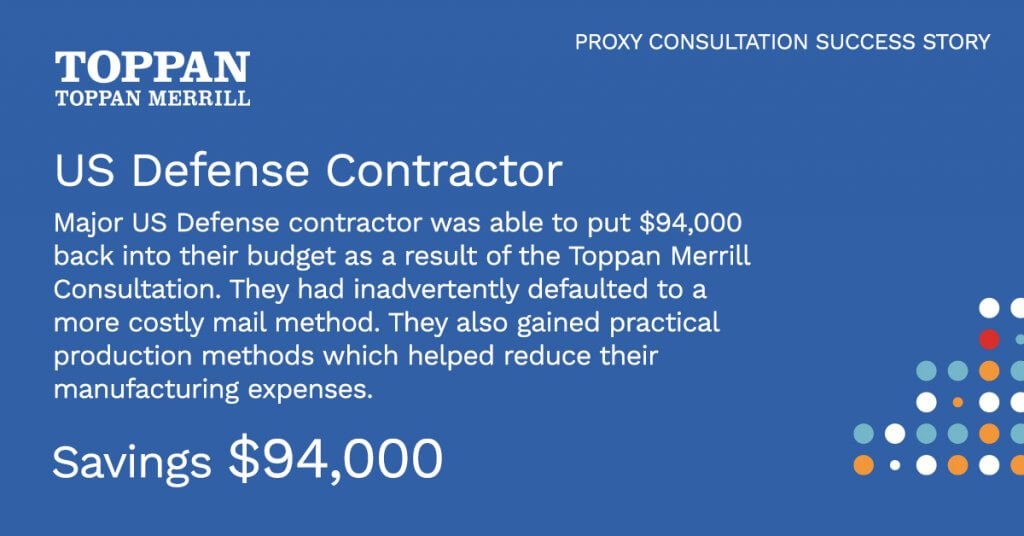
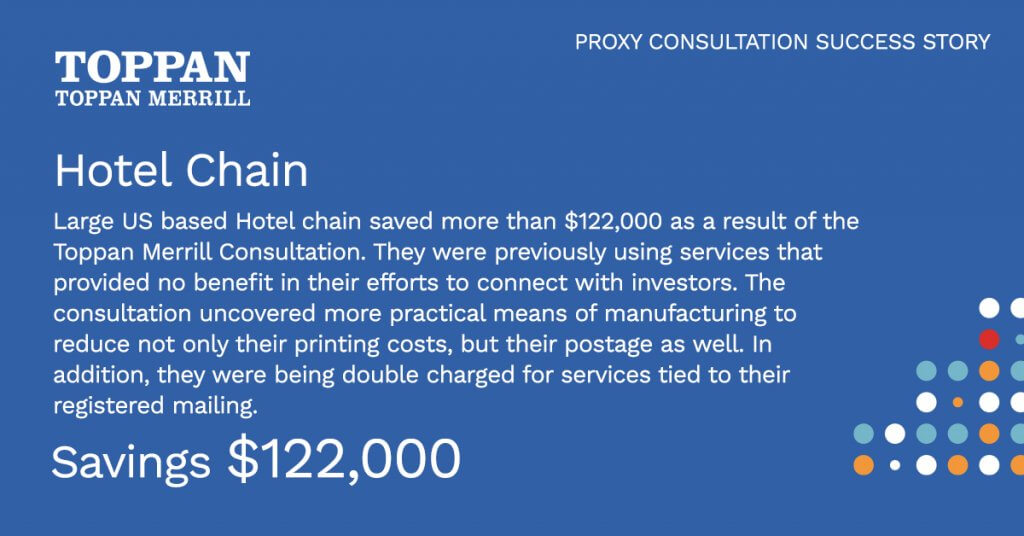
For a comprehensive review of your company’s annual meeting and proxy delivery options, sign up for a free consultation today.
The Notice and Access rule adds a major time crunch
The SEC requires that the Notice be completely mailed out a full 40 days prior to the annual meeting. That, in and of itself, adds to the time crunch of preparing proxy statements and related materials. But here’s where it gets worse: Broadridge wants printed materials for shareholders that request printed materials (and every issuer has some number of shareholders who proactively require hard copies) to be available for mailing several days prior to the mail date. This places undue pressure on issuers to compress their timelines and often requires a “pencils down” demand 45-50 days before the annual meeting. The annual meeting process is complex enough without adding any extra stress on an already tight timeline.
Shareholder participation is down as a result of N&A
Again, in theory, Notice and Access sounds good: Shareholders get access to online materials. So, why is retail voting down 70% with N&A as reported by many distribution agents and solicitors? Investors who are accustomed to receiving a 9 x 12 envelope annually with shareholder materials and a proxy card enclosed are now receiving a 6 x 9 envelope that is similar to the unsolicited mail most people receive every day. Most of these correspondences are ignored as “junk mail.” For those who do open the information, they are only alerted that they are not receiving materials and are given instructions on where to review the online documents and how to access voting. For this process to be successful, the recipient must:
- Open the letter
- Read the letter
- Go online and manually enter the URL
- Access the materials
- Visit another site to vote their shares
Low retail shareholder participation is a big problem
The elimination of the discretionary vote has affected many companies with large numbers of retail shareholders — and it’s creating big problems for issuers. With brokerage firms no longer allowed to vote on retail shareholders’ behalf, and issuers dealing with more proposals requiring shareholder support (i.e., executive compensation, election of directors, etc.), more companies are struggling to gain that support. This typically results in expensive third-party shareholder outreach campaigns (adding more to the cost of embracing the N&A solution). Moreover, low retail shareholder voting ends up giving an outsized voice to institutional investors and can leave retail shareholders feeling disenfranchised — things that most issuers would like to avoid.
If the goal is to go “green”, true electronic delivery is the answer — and is vastly different than N&A
The reality most companies don’t realize is that the e-proxy offering through N&A is very different from electronic delivery (“e-delivery”). For N&A recipients, the issuer establishes a predetermined threshold (usually based upon the number of shares an investor holds) to either send a full set or the notice of internet availability form. This notice is a one-page postcard that alerts the recipient that materials are available online for viewing. The notice also directs the recipient to the applicable voting sites. Most recipients of this mailer ignore the contents (in fact, it’s frequently mistaken for unsolicited junk mail). In addition to being ineffective at connecting with investors, it is a costly and inefficient process.
By contrast, true e-delivery is an e-mail message to the shareholder containing direct links to the actual documents and voting sites. By promoting this approach, issuers can realize greater shareholder engagement and cost savings. True e-delivery is inexpensive (as compared to N&A), at just $.32 per shareholder; affords the recipient the opportunity to review and vote immediately; and, most impressively, generates 5-6 times greater shareholder participation as compared to receiving materials by mail — and 10-15 times greater participation than the N&A model. Annual reviews of the vote return invoice for thousands of companies routinely validate these statistics.
It’s not hard to convince shareholders to opt-in for e-delivery
The one catch with e-delivery is that it’s an opt-in process for shareholders. That means issuers are required to proactively promote this option to their shareholders and convince them of the benefits. This sounds like a hurdle, but Toppan Merrill has helped many issuers successfully get a large portion of their shareholders to enroll in the program — and we’ve observed that those successful companies followed all or some of these best practices:
- Inform shareholders that you are promoting e-delivery in an effort to maximize retail shareholder engagement and make it easier for shareholders to make their voices heard.
- Provide back-up data/statistics to educate shareholders on how e-delivery increases voter participation.
- Demonstrate the convenience of receiving materials and voting via e-delivery.
- Present metrics supporting how e-delivery promotes smart cost reduction and sustainability by eliminating the costs and resources associated with printing and mailing materials.
- Provide a convincing call to action within shareholder communications to drive shareholders to opt in to e-delivery. Consider adding incentives for enrollment in e-delivery and voting online, such as making charitable donations or contributing to eco-friendly causes for every participant enrollment.
Don’t let inertia lead to wasted cost and lower engagement
Many companies have jumped on the Notice and Access bandwagon over the past decade with the best of intentions — cost-savings, sustainability, increasing shareholder convenience, etc. It is easy for companies to assume their N&A program is achieving these results. However, nearly 700 annual meeting and proxy consultation reviews don’t lie — our audit leaves most companies surprised to find they’re not achieving most (or any) of these goals.
Is it Time to Reevaluate Your Notice and Access Strategy?
When Notice and Access was introduced, many issuers adopted it with the expectation of reducing costs and improving the shareholder experience. However, changes in shareholder behavior, voting participation trends, and distribution costs have led many organizations to reassess whether their current approach is delivering the intended results.
While Notice and Access may still be an effective option for certain issuers, it is important to periodically evaluate whether it aligns with your company’s goals for cost management, shareholder engagement and annual meeting outcomes.
Questions issuers should consider include:
- Has retail shareholder voting participation increased, decreased, or remained flat since implementing Notice and Access?
- Are the anticipated printing and mailing savings being offset by Notice and Access fees and ancillary services?
- Are there indirect expenses associated with Notice and Access? Such as solicitation services, secondary mailings, multiple SEC filings or rushed print production fees?
- Does the 40-day Notice and Access timeline create unnecessary pressure on proxy preparation and filing schedules?
- Would a larger percentage of shareholders benefit from electronic delivery options?
- Are current distribution methods helping or hindering shareholder engagement?
When Notice and Access May Make Sense
Notice and Access may be appropriate for issuers with very large shareholder bases, high levels of digital adoption, or established shareholder communication programs that successfully drive online engagement.
When Full-Set Delivery May Be More Effective
For issuers focused on maximizing retail shareholder participation, full-set delivery may provide a more direct and familiar voting experience while reducing the risk that materials are overlooked. Based on shareholder demographics.
When eDelivery Should Be Prioritized
For companies seeking both cost savings and increased shareholder engagement, electronic delivery often provides a compelling alternative by giving shareholders immediate access to materials and voting platforms.
Why Regular Distribution Audits Matter
Distribution strategies should not be viewed as a “set it and forget it” process. Annual reviews of voting participation rates, distribution costs, shareholder preferences, and solicitation expenses can help issuers identify opportunities to improve efficiency and strengthen shareholder engagement.
How Toppan Merrill can help
If you’re interested in hearing how Toppan Merrill has helped issuers to rapidly increase enrollment in e-delivery and improve shareholder engagement — or would like to get a free N&A consultation — contact us today!