 for
for Streamline quarterly and annual reporting with precision and efficiency
As a private company, whether you’re considering going public or looking for a more efficient way to collaborate on your financial reports, Toppan Merrill can help.
Toppan Merrill Bridge™, our SaaS financial reporting platform, coupled with dedicated consultants available 24/7, means your team can work with confidence knowing your reports are accurate, secure and can be delivered on time to key stakeholders.
As your reporting requirements evolve, leverage 55+ years of capital markets and regulatory expertise to navigate the ever-changing disclosure landscape.
Speed, accuracy and expertise. That’s Toppan Merrill.

In control, never alone with Toppan Merrill Bridge
With Bridge, you are in full control of the entire document lifecycle with a dedicated Toppan Merrill consultant serving as an extension of your team, ready to provide guidance and answer questions.
If you know Microsoft® Word, Excel® and PowerPoint®, then you already know Bridge.
How we help
Document Management
Use Bridge to manage content with features including multi-user collaboration, Excel single and full table linking, document version history and comparison, and outputs to Word and PDF.
Service
Lean on the deep expertise of Toppan Merrill disclosure consultants to help your team deliver accurate, on-time reports that meet the requirements of key internal and external stakeholders.
Printing and Distribution
In-house print and distribution services provide the speed and reliability needed to deliver your content to the right audience, on time, every time.
End-to-end ESG Reporting
From first-time ESG reports to well-established reporting processes, Toppan Merrill supports every stage of the journey. We partner with you to deliver technology, content consultation, report production, disclosure support and distribution.

Year after year, our customers rely on the expertise and service of Toppan Merrill
Net Promoter Score
Customer retention
Uptime
Updates and Insights

A smarter way to build your Management Information Circular

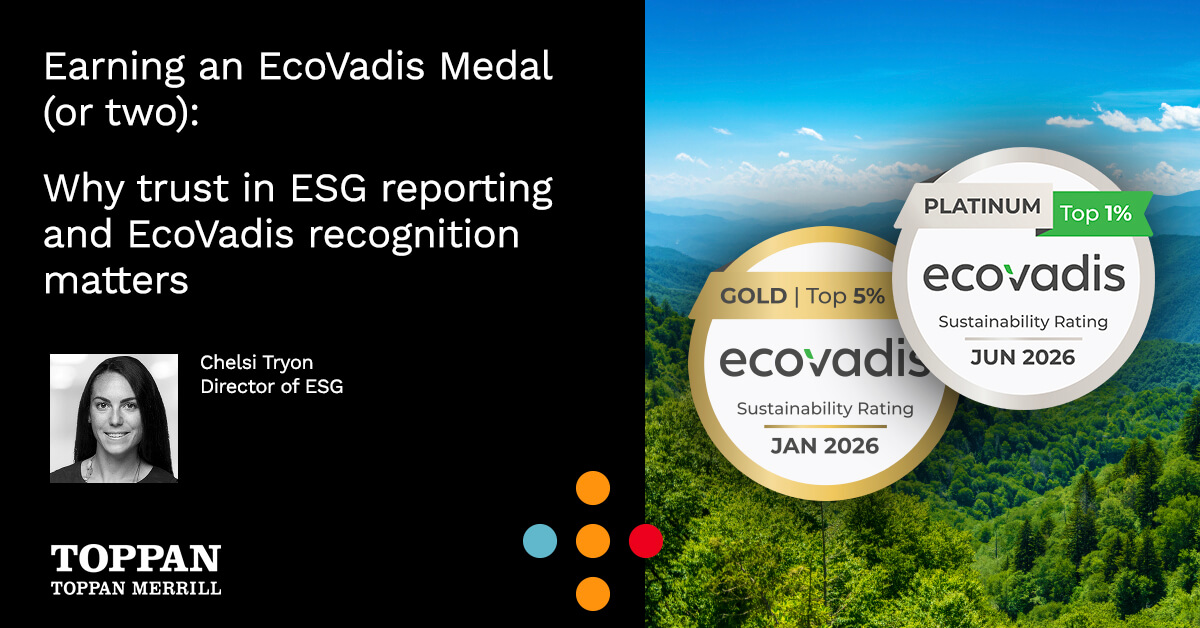
Earning an EcoVadis Medal (or two): Why trust in ESG reporting and EcoVadis recognition matters

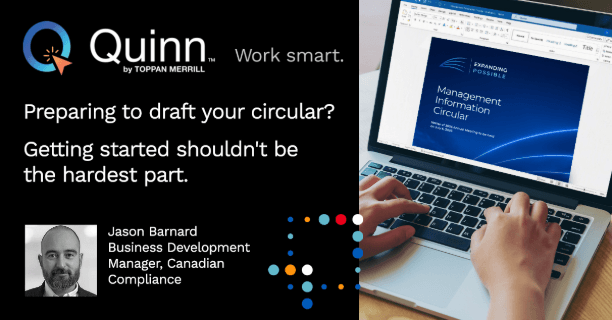
Preparing to draft your circular? Getting started shouldn’t be the hardest part.
Contact our team to get started.
Whether you are in the exploratory phases or ready to move, we are ready to learn about your needs and find the right solution.
Phone
Have more questions?
Reduce complexity and get answers to some of our customers’ frequently asked questions.
See the full list of FAQsAn IPO, or initial public offering, is the term for the first time that a private company sells shares of its stock to the public on a stock exchange. The event means that the company has transitioned from private to public ownership, which is why an IPO is often referred to as “going public.” It’s an opportunity for a company to raise significant capital—to help it fund new growth, for example, or pay off debt. And it allows private investors, like founders, angel investors, and family members, to cash out, often realizing gains on their investment.
An IPO is a big step for a company as it provides the company with access to raising a lot of money. This gives the company a greater ability to grow and expand. The increased transparency and share listing credibility can also be a factor in helping it obtain better terms when seeking borrowed funds as well.
When a company reaches a stage in its growth process where it believes it is mature enough for the rigors of SEC regulations along with the benefits and responsibilities to public shareholders, it will begin to advertise its interest in going public.
For support and additional information, explore our IPO Filing Solutions.
Periodic and interim reporting is the practice of providing company performance reports for periods shorter than a fiscal year, such as monthly, quarterly or semiannual reports. Known as periodic reports, interim reports or interim statements, these updates provide important company information between annual reporting periods.
To help protect investors and keep the public informed, regulations typically require public companies to submit company performance reports more than once a year. Although interim reports are not usually audited, companies must review them to ensure accuracy and distribute them in a timely manner.
Publicly held companies in the U.S. are usually subject to interim reporting requirements, including filing quarterly reports with Form 10-Q in addition to annual reports with Form 10-K. Quarterly reports usually include a balance sheet, income statement and statement of cash flows.
When public companies in the U.S. make important announcements, such as an executive leadership change or bankruptcy, they may also be required to file a current report with Form 8-K. Foreign companies operating in the U.S. may be required to report corporate news and press releases with Form 6-K. For support and additional information, explore our SEC reporting solutions.
The Securities and Exchange Commission (SEC) is the federal agency that oversees investment offerings and financial markets. It is responsible for regulating broker-dealers, investment advisors, exchanges, and public companies to ensure that investors have accurate and transparent information. It also regulates the sale of securities, including initial public offerings.
Congress created the SEC in 1934 in response to the Great Depression. As the first federal regulator of the securities markets, the SEC was tasked with regulating the bucket shops and unethical trading practices that had contributed to the stock market crash of 1929.
Securities offered in the U.S. must be registered with the SEC before being sold to investors. Financial services firms such as broker-dealers, advisory firms, asset managers, and their professional representatives must also register with the SEC to do business.
XBRL stands for eXtensible Business Reporting Language. It is an open-source, XML-based standard for communicating and exchanging financial and business information.
The main purpose of XBRL is to facilitate the sharing of financial and business information in a standardized and efficient manner. It allows for the tagging of individual pieces of data within financial statements, making it easier to analyze and compare data across different companies and industries.
XBRL has gained widespread adoption around the world, particularly in the realm of financial reporting. It is used by regulatory bodies, such as the SEC in the United States, to require public companies to file financial statements in XBRL format, and by companies to communicate their financial results to investors and other stakeholders.